
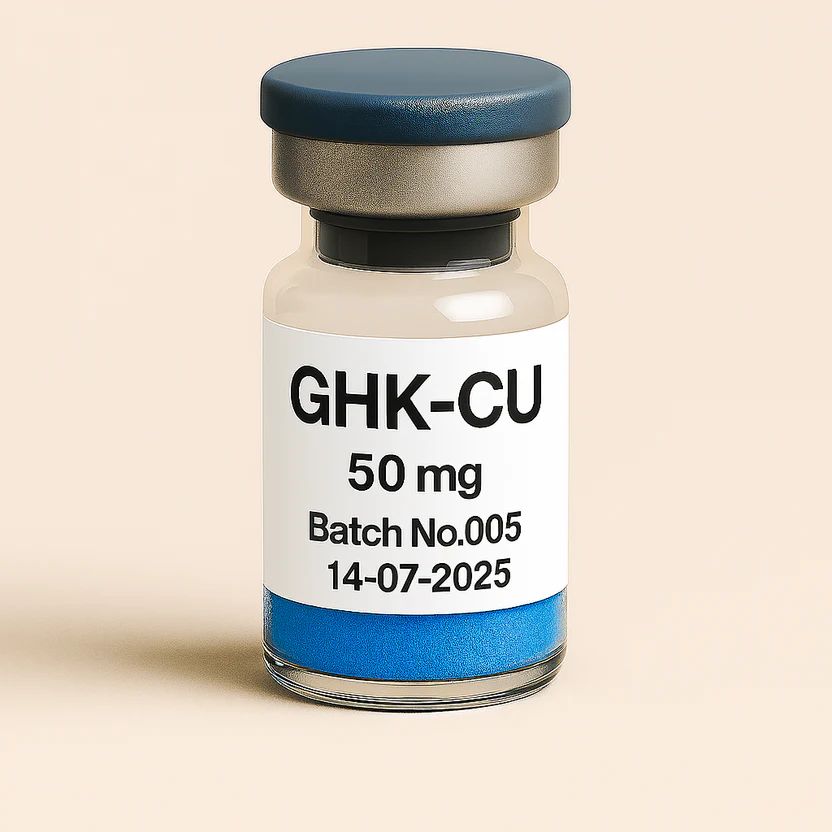
GHK-Cu (copper tripeptide-1) is best viewed as a cosmetic / investigational tissue-repair peptide, not a proven general regenerative drug. The strongest evidence is for topical skin-aging / skin-quality support and wound-healing biology, but much of that evidence is still preclinical, small, short-term, or review-based rather than large modern clinical trials. Evidence for hair growth is promising but thinner than the marketing suggests, and evidence for injectable GHK-Cu is especially limited.
Additional benefits of GHK-Cu under investigation
| Benefit | Take-away |
|---|---|
| 1. Skin aging / wrinkle reduction | This is the clearest practical use case. Small controlled human studies and reviews suggest improved skin appearance, elasticity, and wrinkle-related measures, but the evidence base is not large. |
| 2. Wound-healing / tissue repair | Strong biologic rationale and substantial lab/animal literature; some human support exists, but it is not a broadly established medical therapy. |
| 3. Hair-growth interest | There is mechanistic and early clinical interest, but the human evidence is limited and often involves combination products rather than clean GHK-Cu-alone trials. |
| 4. Anti-inflammatory / antioxidant signaling | Frequently described in reviews and plausible mechanistically, but this does not automatically translate into major clinical benefit. |
| 5. Collagen / ECM support | Likely part of why it is used in anti-aging products; this is one of the most repeated mechanistic themes in the literature. |
| 6. Skin barrier / repair support | Reasonable cosmeceutical framing, especially for topical formulations, though still not a substitute for established dermatologic therapy. |
| 7. Generally acceptable topical tolerability | Cosmetic safety assessments and in-vitro irritation work are reassuring for topical use as used in cosmetics, but that does not prove safety for every route or every dose. |
| 8. Not a proven broad “healing peptide” | Marketing usually outruns the evidence. The data support a narrower skin/cosmetic/regenerative interpretation, not a catch-all anti-aging medicine. |
2. Molecular mechanism of action
2.1 Receptor pharmacodynamics
GHK-Cu does not behave like a classic receptor-targeted drug with one clean receptor mechanism. It is a small copper-binding peptide whose proposed actions include copper delivery / modulation, extracellular-matrix signaling, and changes in expression of genes involved in inflammation, remodeling, and repair. The literature often describes it as a signaling peptide rather than a conventional pharmacologic agonist or antagonist.
2.2 Downstream biology
| Pathway / theme | Functional outcome | Context |
|---|---|---|
| Collagen / elastin / glycosaminoglycan support | May improve firmness, elasticity, repair | Skin aging / cosmeceuticals |
| Wound-healing signaling | Supports remodeling, angiogenesis, repair biology | Regenerative / wound literature |
| Anti-inflammatory / antioxidant effects | May reduce inflammatory signaling and oxidative stress | Mechanistic / preclinical literature |
| Hair-follicle support hypotheses | Possible follicular / scalp relevance | Hair-growth research, still exploratory |
These mechanisms make biologic sense, but they are still not the same thing as strong clinical proof. That distinction is important with GHK-Cu because the marketing language is often broader than the human trial evidence.
3. Pharmacokinetics
Most practical use is topical. For skin products, a central issue is not exotic systemic pharmacology but whether enough peptide actually penetrates the skin barrier in useful amounts. Reviews note that GHK-Cu is relatively hydrophilic and that formulation matters; liposomes and other delivery systems may improve penetration. Human skin-penetration work supports at least some retention / transport, but delivery remains a real formulation constraint.
That is why “GHK-Cu works” is too simplistic. The likely answer is closer to: some topical formulations may have useful local effects, but performance depends heavily on formulation and exposure.
4. Pre-clinical and clinical evidence
4.1 Skin aging / anti-wrinkle use
This is the best-supported practical niche. Reviews of topical peptide studies report improvements in wrinkle appearance, elasticity, firmness, and overall skin quality, and a 2024 review specifically framed GHK / GHK-Cu as an anti-wrinkle peptide with human volunteer data behind it. Still, the human studies are generally small and not decisive by modern therapeutic standards.
4.2 Wound healing / tissue repair
The wound-healing story is strong biologically and supported by extensive preclinical literature. Reviews describe effects on fibroblasts, extracellular matrix remodeling, angiogenesis, and tissue repair, and newer biomaterials work continues to use GHK-Cu as a wound-healing payload. But this remains more of a regenerative research platform than a standard clinical wound drug.
4.3 Hair growth
GHK-Cu is commonly marketed for hair growth, but the evidence is less mature than its reputation. There is in-vitro support and some early human or combination-product research, but not a large, clean body of GHK-Cu-alone randomized trials comparable to established hair-loss drugs. So the right wording is promising / exploratory, not proven.
4.4 General “anti-aging” claims
A lot of anti-aging language around GHK-Cu comes from mechanistic reviews, gene-expression discussions, and cosmetic outcomes rather than disease-treatment trials. That makes it reasonable to describe GHK-Cu as an interesting cosmeceutical ingredient, but not as a validated systemic anti-aging therapy.
5. Emerging clinical interests
| Field | Rationale | Status |
|---|---|---|
| Topical skin rejuvenation | Best human-facing evidence | Supportive but modest |
| Wound healing / repair | Strong biologic rationale | Preclinical-heavy / translational |
| Hair growth | Follicle and scalp signaling interest | Early / limited human evidence |
| Injectables / systemic peptide clinics | Commercial expansion | Poorly supported; more caution warranted |
6. Safety and tolerability
For topical cosmetic use, the safety picture is fairly reassuring. The Cosmetic Ingredient Review concluded these peptide ingredients, including copper tripeptide-related materials, are safe in cosmetics under current practices of use and concentration, and in-vitro work found GHK-Cu had a low irritation potential compared with other copper compounds.
That said, the reassuring safety story mainly applies to cosmetic-style topical exposure, not to every possible route. FDA has specifically flagged injectable compounded GHK-Cu as concerning because of limited human safety data and risks related to immunogenicity / peptide impurities.
7. Contraindications and cautions
Use extra caution with:
- Injectable / compounded GHK-Cu, because human safety data are limited and FDA has identified safety concerns for compounded injectable use.
- People with copper-handling disorders or unexplained sensitivity to topical actives, because this is a copper complex and irritation / idiosyncratic reactions are still possible even if average topical tolerability looks good.
- Anyone replacing established treatment for wounds, hair loss, or dermatologic disease with GHK-Cu alone, because the evidence does not justify using it as a proven substitute for standard care.
- Pregnancy / breastfeeding or chronic systemic use, because the public evidence base is much stronger for topical cosmetics than for broader medical use.
8. Comparative practical matrix
| Feature | GHK-Cu |
|---|---|
| Main strength | Topical skin-quality / anti-aging interest |
| Best-supported use case | Cosmetic skin rejuvenation / repair support |
| Wound-healing evidence | Strong preclinical, weaker as standard clinical therapy |
| Hair-growth evidence | Promising but limited |
| Core limitation | Human clinical evidence is modest and formulation-dependent |
| Short-term topical tolerability | Generally favorable |
| Main safety concern | Route matters; injectables are much less reassuring |
| Best practical framing | Cosmeceutical / investigational regenerative peptide, not a proven broad therapy |
9. Regulatory landscape
GHK-Cu is best thought of as a cosmetic ingredient / research peptide, not an approved mainstream medical therapy for anti-aging, wound healing, or hair growth. The most important current regulatory caution is that FDA has identified injectable compounded GHK-Cu as a substance with limited human safety information and potential safety risks.
10. Future directions
The most useful future work would be:
- better dose- and formulation-specific topical trials,
- clearer GHK-Cu-alone studies rather than blend products,
- larger randomized trials for hair growth,
- and better human safety data if anyone is claiming benefits beyond standard topical cosmetic use


Reviews
There are no reviews yet.